

Growing up in India, many people believed that traveling to the US was “like going to paradise,” D’Souza told Freedom Magazine. After all, America represents prosperity, dignity and possibility—and for a boy raised in a one-room home without running water or electricity, the idea carried almost mythical weight.
Years later, that dream would lead D’Souza into one of the darkest chapters of his life—and ultimately into a global mission to ensure others never make the same journey blindly.
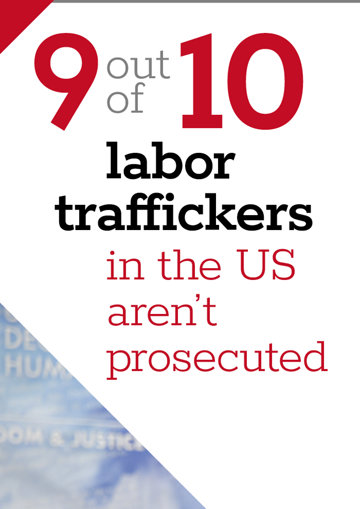
“Out of 10 traffickers, nine do not get prosecuted. That is why trafficking is flourishing so much.”
Today, D’Souza is known internationally as a labor trafficking survivor, human rights educator and public speaker. His story has taken him from poverty in India to meetings in the White House, and from a Cincinnati restaurant—the scene of his exploitation—to roles that have influenced anti-trafficking policy throughout the world.
Yet D’Souza’s newest priority is surprisingly simple: Teach people their rights before traffickers ever have a chance to exploit their ignorance.
His transformation illustrates a reality often overshadowed by the disproportionate public attention to sex trafficking: Labor trafficking remains widespread, underreported and misunderstood. Through Eyes Open International, the nonprofit D’Souza co-founded with his wife Dancy, and through his human rights education work, he is working to move the conversation upstream—from rescue to prevention, crisis response to awareness.
His remarkable journey began in Vadodara, a city in the western Indian state of Gujarat, where hardship was a fact of daily life. “Growing up as a child, I never knew that we were poor because that was life,” he says. “Our neighbors’ situation was worse than ours.” But going to America “was a dream for every Indian.”
D’Souza’s achievements were hard won. “From third grade to 10th grade, I failed in all the subjects,” he says. But he eventually overcame years of academic struggle to earn law and commerce degrees from The Maharaja Sayajirao University of Baroda.
By the time he was a young adult, D’Souza had secured employment as a telephone operator, went on to work in banking and eventually rose to senior management positions in India.
Then, in 2003, came the opportunity that appeared to validate years of hard work and ambition: He was offered a position in the US as a business development manager, earning $75,000 a year, plus benefits.
“By Indian standards,” he says, “that was a lot of money.” He accepted the offer and traveled to Cincinnati with his wife and their two young sons.
But the promised career never materialized. Instead, the owner of an Indian restaurant confiscated the family’s passports and money and forced D’Souza and his wife to work punishing hours without pay—or even adequate food. Threats became a constant in their lives.
D’Souza realized that the job offer had been a hoax designed to lure him and his family into exploitation.
The intimidation followed a script D’Souza can still recite from memory.
“Traffickers use four words to threaten victims,” he explains. “Number one, they tell victims they will get ‘arrested.’ Number two, they say they will get ‘handcuffed,’ and number three, that they will get ‘jailed.’ Finally, number four, that they will get ‘deported.’
“No human being on this planet would like to hear those four words.”
Over time, D’Souza emphasizes, fear becomes its own prison.
Researchers and advocates have increasingly noted how labor trafficking flourishes in precisely such conditions. Victims often arrive legally, know little about local laws and remain isolated from support systems. Cases of exploitation also frequently escape public attention. In short, as D’Souza pithily puts it, exploitation remains a low-risk, high-reward crime, and the incentives for perpetrators remain dangerously favorable.
“The risk factor in labor trafficking in the United States of America is very thin,” he says. “And the profit margins are very thick. Even today, out of 10 traffickers, nine do not get prosecuted. That is why trafficking is flourishing so much.”
Eventually, with assistance from community members, legal advocates and law enforcement agencies, the D’Souzas escaped. Their trafficker was never prosecuted, though the family did prevail in a civil case and went on to slowly rebuild their lives.
Cincinnati became home rather than a place of captivity.
D’Souza’s reasoning is as pointed as it is straightforward: Informed people are harder to exploit.
In 2008, D’Souza got a job at Cincinnati Children’s Hospital Medical Center. Three years later, he and his wife purchased a home. And in 2023, D’Souza officially became a US citizen. Along the way, Presidents Barack Obama and Donald Trump retained him as a member of the United States Advisory Council on Human Trafficking.
Even as his advocacy work gained national recognition, D’Souza struggled with lingering feelings of guilt and failure. His most telling explanation may be the one he now uses as a teaching tool: “I tell people that I failed on the ‘Four P’s.’ I failed as a parent. I failed as a provider. I failed as a protector, and I failed as a person.”
D’Souza pauses before describing the transformation that followed.
“But with God’s grace, the support of law enforcement agencies and enlightenment on human rights, I flipped the four P’s into passion, purpose, power and prayers.”
That philosophy now drives virtually everything D’Souza does. Since 2019, he has focused increasingly on human rights education, partnering with United for Human Rights—the world’s largest nongovernmental human rights education and public information campaign, sponsored by the Church of Scientology—and its youth program, Youth for Human Rights International. He regularly distributes the programs’ educational materials, built around the United Nations Universal Declaration of Human Rights, and speaks at schools, conferences and international gatherings.
D’Souza’s reasoning is as pointed as it is straightforward: Informed people are harder to exploit. He frequently refers to Article 4 of the Universal Declaration of Human Rights, which prohibits slavery in all its forms. Every child, D’Souza argues, should know all 30 of their human rights long before adulthood.
For D’Souza, that education is not abstract. It teaches people to recognize exploitation in the ordinary places where it can remain hidden in plain sight.
“Labor trafficking in the United States of America happens at four places—restaurants, gas stations, convenience stores and motels,” he says.
His message is not merely to authorities or policymakers, but to everyone who walks into those businesses: Pay attention. If something appears wrong, do not look away. “If you suspect anyone is a victim of labor exploitation, please call 1-888-373-7888,” he urges, referring to the National Human Trafficking Hotline, which accepts anonymous reports.
For a man whose own exploitation continued behind the doors of a neighborhood restaurant, the appeal is deeply personal. How could it not be?
Harold Henry D’Souza arrived in America believing he was stepping into paradise.
Instead, he entered a nightmare that unfolded in plain sight—yet went unseen.
Twenty-three years later, his mission is no longer limited to reclaiming a lost dream. It is about making sure future generations carry something more durable than hope when they cross borders—knowledge, vigilance and an understanding that every human being possesses rights no trafficker has the authority to take away.