

Well, no, not unless you’re rich enough to afford it.
In a recent op-ed marking Sunshine Week—the national celebration of government transparency—Dr. David Cuillier revealed that bureaucrats routinely hit FOIA requesters with outrageous fees, putting public records out of reach for most Americans.
Cuillier, director of the Joseph L. Brechner Freedom of Information Project at the University of Florida, and Wagner, an associate professor of journalism and media studies at Marquette University, documented the problem in their 2023 study “To Fee or Not to Fee: Requester Attitudes Toward Freedom of Information Charges”—showing that if you want to use FOIA to obtain government information, you may need very deep pockets indeed.
“On paper, all of us are equal in FOIA law, but it turns out that some of us are more equal than others.”
“Requesting public records to see what our government is up to should not be reserved for the rich,” Cuillier said. “This is a fundamental right in a democracy, in a free republic, for every person, no matter their status, to see the very documents they paid for with their taxes.”
In their research, the pair surveyed 330 people who had tried to obtain information through FOIA and found that “private citizens, journalists, academics and nonprofit requesters were more likely to identify excessive fees as a serious impediment, whereas commercial requesters and lawyers did not.”
Some of the cases cited in the report are so extreme as to be virtually unbelievable.
An advocacy group seeking sheriff’s records on predictive policing software was hit with a $1.2 million price tag.
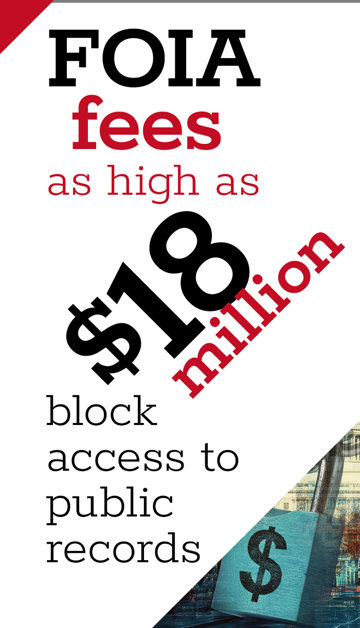
A Michigan parent was told it would cost $18 million for information on how a local school district monitored social media.
And a Maryland nonprofit was told it would have to pony up $245,000 for police records of officer misconduct.
Cuillier noted that due to overcharging and other delay tactics by government bureaucrats—used to dodge their legal duty to provide information—the rate of full release of requested documents plummeted from 38 percent in 2011 to just 12 percent in 2024. Meanwhile, the average time to fulfill requests nearly doubled, soaring from 24 to 44 days.
“If fees dissuade public-interest requesters, such as citizens and journalists, from acquiring records, then under democratic theory, informed self-governance is threatened, not to mention practical benefits to society,” the study states.
Scientology Founder L. Ron Hubbard put it plainly—and profoundly: “Democracy depends exclusively on the informedness of the individual citizen.”
Cuillier argues the findings point to a widening gap between those who can access public records—and those who are effectively shut out.
According to his research, the ability to obtain government information under FOIA can be contingent on a requester’s economic or social class—perhaps the lowest form of hypocrisy and discrimination carried out by agencies of a government that promises equality for all.
“Government agencies also have been found to discriminate against those in less prestigious rungs of society, such as marginalized minority populations,” Cuillier wrote. “One study showed that government custodians sometimes ‘Google’ requester names and are more likely to respond to requests coming from a university professor than those coming from a doorman or ‘cleaning lady.’”
“On paper,” Cuillier observed, “all of us are equal in FOIA law, but it turns out that some of us are more equal than others.”
“This isn’t about politics,” he continued. “It’s about good governance, and better lives for everyone. Because, we know, access to public records matters. Studies have shown that public record laws lead to cleaner drinking water, safer restaurants and lower taxes. Those skilled in acquiring public records can buy a home with confidence, background babysitters, keep tabs on their local government and find the best schools for their children.”
Yet access to these vital records is too often blocked—not just by fees, but by a range of bureaucratic tactics designed to slow, frustrate and even deny requesters the information they’re legally entitled to.
“Agencies regularly over-redact and over-withhold information under FOIA,” Brett Max Kaufman, attorney for the ACLU, said. “There’s a culture of keeping things as secret as possible for as long as possible, in part because all of the incentives run in that direction.”
One consequence of that secretive culture is a tactic known as “glomaring,” named after Howard Hughes’ deepwater recovery ship, the Glomar Explorer, used in a top-secret underwater search. With glomaring, agencies simply say they “can neither confirm nor deny” whether they have the requested information—or that it even exists.
America has a long history of battling government secrecy. In 1776, the Declaration of Independence accused the king of deliberately forcing legislative bodies to meet “at places unusual, uncomfortable and distant from the depository of their Public Records, for the sole purpose of fatiguing them into compliance with his measures.”
Centuries later, the principle hasn’t changed: Bureaucrats and even kings know that information is power.
We fought a war then—a revolution—in part to secure full freedom of government information. And 250 years later, that fight is far from over.
Why? Because no one is as territorial and self-protective as a government bureaucrat when it comes to yielding even the smallest piece of their kingdom.
But this is a war that, as a democratic society, we must win.
Cuillier offers a blueprint for how we, as a society, can wrest control of government information back from entrenched bureaucracies.
The government needs to invest in technology that makes the public records system “seamless, simple and understandable,” Cuillier wrote.
People should never be charged exorbitant fees for information they have already paid for with their taxes.
Nonprofit coalitions for open government should be established in every state, and each state should have “transparency guardians”—independent enforcement officials who can compel government agencies to obey FOIA law and do their jobs—at minimal or no cost.
And the public—including children—should be taught how to access government information, both through schools and public service announcements.
“It’s time to invest in democracy and the power of information,” Cuillier said.
“It’s time to put the ‘us’ back into US FOIA.”