

With the lamps of religious freedom flickering out in so many parts of the planet, and with two-thirds of the world’s population living in 62 nations where believers face the threat of persecution, what hope do we have?
“To me,” he told Freedom, “one of the most hopeful signs is the scope and momentum of the international religious freedom movement today. Numerous governments now prioritize this issue in their foreign policies and cooperate through networks like an international contact group.… And NGOs cooperate through various roundtables. This is key because religious persecution is a global problem that requires global solutions.”
With the end of 2025 in sight, and in a month brimming with religious observances—from Christmas to Hanukkah, from Bodhi Day to the Pancha Ganapati Hindu festival, from the Wicca observance of the Yule solstice to the Zoroastrian Day of Remembrance—now is a good time to look back on the year and find those “most hopeful signs” Mr. Schneck was referring to.
Following is a collection of the 10 brightest religious freedom stories of the year, in no particular order—selected from a deep and lovely well of “most hopeful signs” this year.
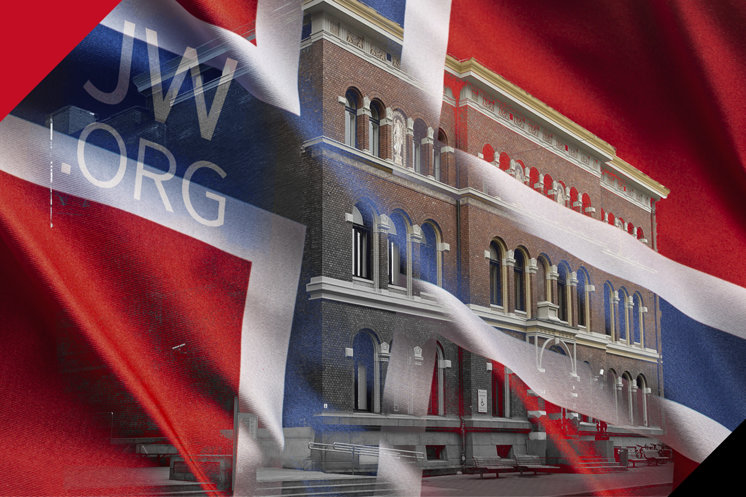
1. Norway Court of Appeal Affirms Jehovah’s Witnesses’ Right to Practice Their Religion, March 2025
It was called “the most important trial about a religious freedom issue in Norway in decades.” The Borgarting Court of Appeal reversed a decision denying state subsidies and registration to the Jehovah’s Witnesses of that nation. Based on a bigoted determination by Oslo County’s governor in January 2022 that the community was in violation of Norway’s Religious Communities Act, the faith was stripped of its rights and privileges as a religion.
When a faith in Norway loses its registration, it may no longer solemnize marriages. And along with its rights as a religion, Jehovah’s Witnesses were also denied their annual grants for, among other things, humanitarian disaster relief work.
Worse, the community—already facing the prospect of imminent extinction—now became a target for violence. In September 2022, a man attempted to assault two Jehovah’s Witnesses in Harstad. That same month, a Jehovah’s Witnesses mobile display car was set on fire, and in October, an attempted arson attack targeted a Jehovah’s Witnesses facility in Fauske.
Applauding the Court of Appeal’s decision, a spokesperson for the religion said, “We sincerely hope that this judgment will further strengthen Norway’s reputation as a nation that embraces religious diversity.”

2. French Court of Cassation Affirms Religious Freedom in Deacon Dismissal Case, April 2025
In a refreshing pivot from its restrictive stance on religious freedom, France’s highest court for civil and criminal matters ruled that secular judges cannot review decisions of religious courts. At issue was the Catholic Church’s dismissal of a deacon. Could a purely ecclesiastical decision, made within the bounds of church law, be reviewed and overturned by a secular judge? An affirmative ruling by the high court would risk placing every internal decision of every religious body at the mercy of civil courts.
In the end, the French high court ruled that the church’s decision was based on internal religious rules and that such rules are outside the province of civil judicial review.
This is the same nation whose government has steadfastly ignored its own laws on the separation of church and state. In 2023, for example, France passed legislation allowing officials to use “special techniques” to investigate religious minorities it labeled as “cults.” Those found guilty of “exploitation” through “sectarian” activities could face a fine of up to 1 million euros and seven years in prison.
As Freedom noted, “The Court of Cassation’s recent decision is a refreshing and long overdue departure from France’s practice of interfering with religions, offering hope for a future where all faiths and their followers can practice freely in the land of liberté, égalité, fraternité.”
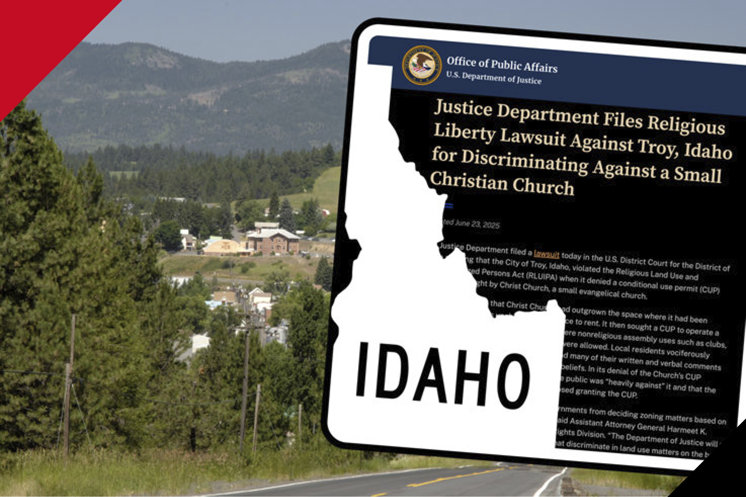
3. Department of Justice Sues Idaho Town for Religious Discrimination Against Christ Church, May 2025
Christ Church has a small congregation in the town of Troy, Idaho. In 2022, an elder of the church bought a building on Troy’s main street and applied for a conditional use permit as a Sunday morning meeting place for parishioners. In March 2023, the Troy City Council denied the application. Why? The city council said it was “against the will of the people and will have a negative effect on the City’s ability to grow its business community.”
The DOJ disagreed, saying it was prejudice, and quoted hostile statements by Troy residents and negative media coverage denigrating the church’s beliefs and practices. Invoking the Religious Land Use and Institutionalized Persons Act (RLUIPA), which is there to “protect individuals, houses of worship, and other religious institutions from discrimination in zoning and landmarking laws,” Assistant Attorney General for Civil Rights Harmeet K. Dhillon said, “RLUIPA unequivocally forbids local governments from deciding zoning matters based on their dislike of certain religious groups.”
It’s something of a stretch to believe that a small Sunday morning church service downtown at a time when downtown is deserted is “bad for business.” More likely, the town was trying to cover up its real reason for turning up its nose at a faith community: bigotry.
Why would the federal government concern itself over one tiny church’s denied request to set up shop in one building one day a week in one town of less than 1,000 people? Because, in its own words, “the Department of Justice will not hesitate to file suit against jurisdictions that discriminate in land use matters on the basis of the applicants’ religious beliefs.” It’s comforting to know that in America, every faith community is vital to the whole and denying religious freedom to some is denying religious freedom to all.

4. Church Attendance and Faith Surge in Wake of Pandemic, National Study Finds, June 2025
A five-year study, involving 24,165 parishioners of over 80 denominations, was a resounding affirmation of the health of religion in America. The majority of survey respondents said their religious faith and spirituality had strengthened since the pandemic. Also on the upswing: religious donations, church involvement and community volunteering.
Along with service to the community, another dramatic spike in the percentages was the mushrooming of religious education, with nearly a third saying they had increased their study of their religion.
Thirty-eight percent of respondents said they had started attending their current church within the last five years. And of those new attenders, 8 percent said they had never attended before and 22 percent said they hadn’t attended a congregation “for years.”
“This Place Means Everything to Me” was the report’s title—and its emotional core. The survey’s optimistic findings revealed a post-pandemic landscape in which church communities are not only enduring, but reemerging as vital sources of hope, purpose and belonging.
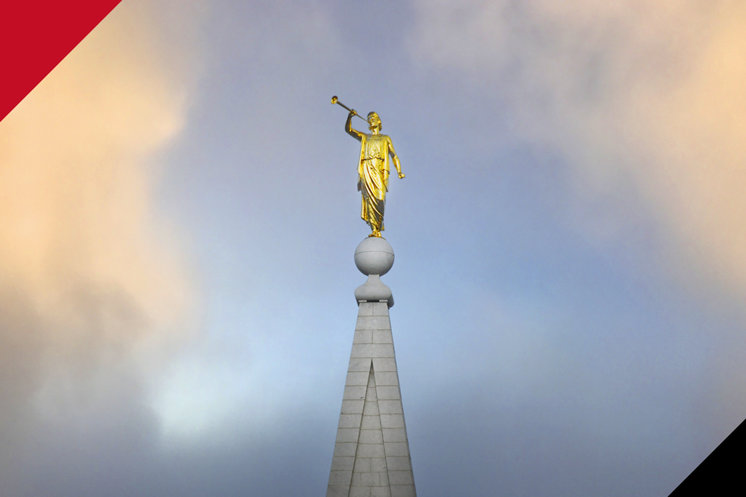
5. Latter-day Saints Win Against Ex-Member Seeking Return of Donations, January 2025
He was a wealthy ex-parishioner who had donated $5 million between 2003 and 2015 following the LDS tithing practice by which all members are expected to donate a tenth of their income. Six years later, he filed a complaint in federal district court alleging that the church had misused his tithes. The court threw the complaint out. He appealed. A three-judge panel at the appeals court reversed the lower court. The Latter-day Saints asked for an 11-judge panel to hear the matter, and this time the decision was unanimous in favor of the Church.
As a court opinion stated, “there is no way in which the plaintiff here could prevail without running headlong into basic First Amendment prohibitions on courts resolving ecclesiastical disputes.” In other words, a dispute over tithes is a matter of religious doctrine, which is hands-off in a civil court.
Eleven other religious communities, including Church of Scientology International, recognizing the importance of the case and the damage it could do to religious freedom, filed a friends of the court brief on the Latter-day Saints’ behalf. The attorney who presented the brief for the 11 religious groups applauded the court’s decision, saying, “We are delighted … at the outcome … and we view it as a complete victory for the Church and for religious liberty generally.”

6. Right Out of the Gate, Pope Leo XIV Forcefully Advocates Religious Freedom, May 2025
The newly elected pontiff made his priorities clear before the ink was dry on the ballots electing him to succeed the late Pope Francis. He sent messages to Rome’s chief rabbi and to the director of interreligious affairs at the American Jewish Committee, promising both to “continue and strengthen the church’s dialogue and cooperation with the Jewish people.”
A few days later, he called for “full respect for religious freedom in every country, since religious experience is an essential dimension of the human person. Without it, it is difficult, if not impossible, to bring about the purification of the heart necessary for building peaceful relationships.”
The first American pope called for the same peaceful relationships within his own religion, welcoming an audience of Eastern Christian pilgrims from the Middle East. Persecuted, their churches burned by Islamic State militants and their communities decimated, Eastern rite Christians have struggled for centuries to keep their traditions and practices intact. Praising their customs and the liturgies “that engage the human person in his or her entirety, that sing of the beauty of salvation and evoke a sense of wonder at how God’s majesty embraces our human frailty,” Leo XIV concluded, “The Church needs you.”
As then-USCIRF Chair Stephen Schneck said: “Throughout the world, we are seeing a significant rise of religious persecution against Christians, Jews, Muslims, Hindus and other religious minorities. It is heartening to see His Holiness speak forcefully on religious freedom so early on in his pontificate.”
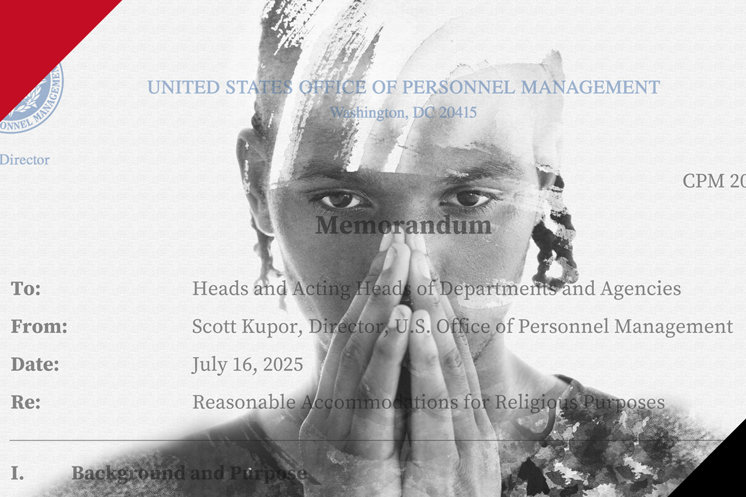
7. Faith at Work: Office of Personnel Management Declares Religious Freedom a Federal Workplace Priority, July 2025
In a historic directive, the US Office of Personnel Management ordered all federal agencies to adopt a more generous stance toward employees’ religious practices, marking a sea change in workplace policy. The directive means that federal agencies must accommodate the religious practices of their employees—through telework, flexible schedules and leave.
Aside from recognizing the dignity and importance of faith in one’s life, accommodating the religious needs of a company’s employees does wonders for the bottom line, as studies by the Religious Freedom & Business Foundation (RFBF) show. Over 85 percent of Fortune 500 companies now embrace religious inclusion as key to their diversity strategy, a figure that, according to RFBF President Dr. Brian Grim, represents a “tipping point” for corporate America.
By recognizing religious freedom as a core workplace value, the federal government has ensured employees no longer have to choose between their faith and their livelihood.
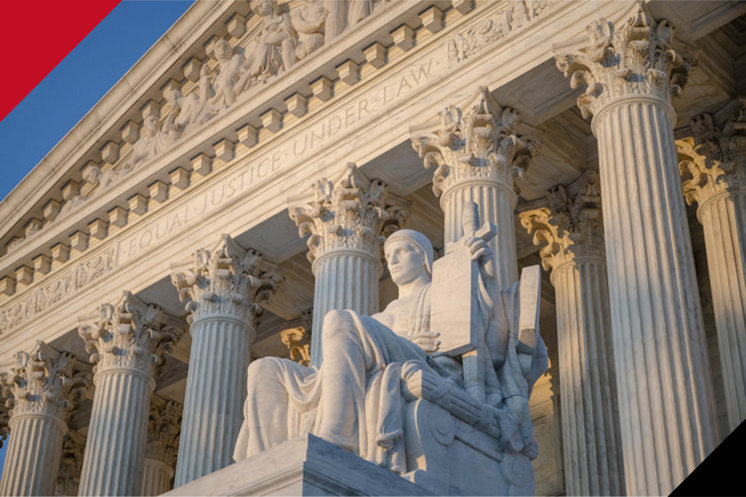
8. “Textbook Discrimination”: Supreme Court Rebukes State of Wisconsin, Paving the Way for Tax Exemption to Catholic Charities, July 2025
They served the poor, providing their help freely and without proselytizing. The Catholic Charities Bureau (CCB) was simply obeying the tenets of its faith, but the Wisconsin Supreme Court thought otherwise. They denied the group’s claim for exemption from the state’s unemployment tax precisely because they weren’t proselytizing or limiting themselves to Catholics only.
In other words, they penalized a religious group for being religious.
The US Supreme Court, in reversing the decision, called the exemption denial “textbook denominational discrimination,” and noted that it is out of bounds for a government agency to evaluate how a church should define its religious purposes.
As Justice Sotomayor wrote in the court’s opinion: “It is fundamental to our constitutional order that the government maintain ‘neutrality between religion and religion.’ … There may be hard calls to make in policing that rule, but this is not one.”
Then, on December 15, the Wisconsin Supreme Court shut down the attorney general’s effort to deny all religions the unemployment tax exemption in order to “legally” deprive CCB of its own. “Attorney General Kaul never should have doubled down on punishing churches,” said Eric Rassbach, counsel for CCB. “The Wisconsin Supreme Court’s order … protects not just Catholic Charities, but every faith-based organization that relies on this exemption to serve the public. It turns out that penalizing charities is not a winning legal strategy.”
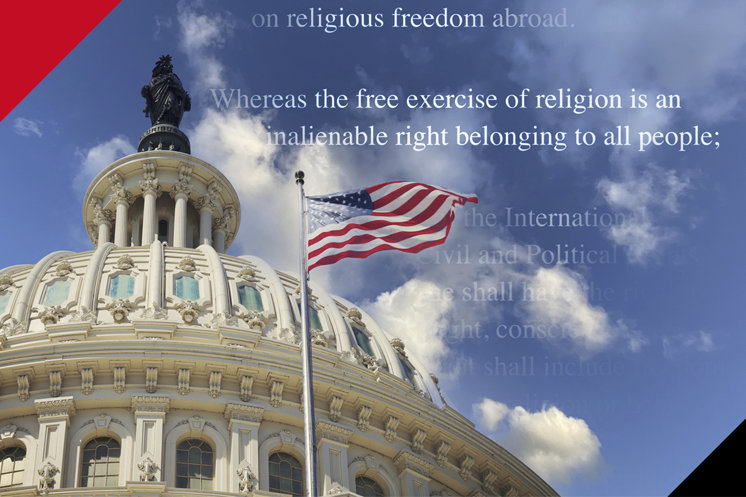
9. A New House Resolution Demands America Stop Turning a Blind Eye to Systematic Assaults on Religious Liberty Abroad, September 2025
“Whereas the free exercise of religion is an inalienable right belonging to all people;
“Whereas Article 18 of the International Covenant on Civil and Political Rights states ‘Everyone shall have the right to freedom of thought, conscience and religion. This right shall include freedom to have or to adopt a religion or belief of his choice, and freedom, either individually or in community with others and in public or private, to manifest his religion or belief in worship, observance, practice and teaching’…
“Resolved, that the House of Representatives … affirms that the United States should actively maintain its position of global leadership in the advancement of freedom of religion abroad.”
With those words, House Resolution 738 was introduced this fall, calling on Congress to reaffirm America’s commitment to international religious freedom. The resolution specifically names severe offenders—countries that persecute their own citizens while maintaining trade and diplomatic relations with the United States—underscoring America’s obligation, as a global champion of religious freedom, to lead by example.
As USCIRF Chair Vicky Hartzler said: “I am so encouraged that Representative French Hill and Representative James McGovern introduced House Resolution 738. It shows how leaders continue to work together across the aisle to advance religious freedom abroad.… Now is the time for these governments to take needed steps to reverse course and embrace religious freedom, which is not just the right thing to do according to international standards, but which also promotes economic prosperity and security for their countries.”
Freedom of worship lies at the heart of the American story. It defines who we are and why we endure. With House Resolution 738, that defining promise can be renewed—transforming a cherished national value into a renewed commitment to stand for religious freedom around the world.
10. Americans More United Than Ever on Religious Freedom, February 2025
Each year, the Becket Fund for Religious Liberty measures America’s support for religious freedom. Becket surveys adults across demographics and religious persuasions, asking whether they support the freedom to choose and worship a religion without persecution; whether they are willing to openly discuss their personal faith with others; and whether they accept religious expression in the public square.
The result: the highest overall approval rating for religious freedom—the human right that makes America America—in six years, putting the lie to the media canard that as a nation we can’t agree on anything. Seventy-five percent of Americans support the freedom to worship without fear of persecution, up nearly 20 percentage points since 2020.
And the happiest surprise: Gen Zers—our future leaders born between 1997 and 2012—embrace religious inclusion and expression more than any other age group.
As Mark Rienzi, Becket’s president and CEO, said, “We should take heart that our nation remains committed to forging a future where faith is a cornerstone of our culture.”
We do take heart.
And hope you do, too.
Happy holidays.